The Second Layer
What a family therapy session, a fighter jet, and a drunk monkey taught me about the internet.

A tree, A peacock, a fire tornado, and a bear.
These were answers when our family therapist asked each of us to think of an image that represented us within the family.
My wife and I began couples therapy a few months ago as a result of wanting to reassess and realign our roles and what we want for ourselves individually, as a couple, and a family. It’s been quite helpful, and along the way we had the opportunity to have a session in person while we were visiting Mexico City, and our children came along.
It was in this context that our therapist asked us to describe the images that represented us in our family. My wife chose a tree swinging its branches during a storm. My daughter Sofi picked a tiger and a peacock before settling in a peacock. My son picked a tornado made of fire. I picked a bear.
She then asked us different questions inviting us to speak to the other from that position. How does a tornado relate to the tree? How does the peacock feel about the bear? How do the bear and the tree interact with each other? The answers were beautiful, touching, and insightful.
The images let us move through complex territory that language alone would have flattened. Not because words are inadequate, but because some things, especially the messy human stuff, we feel before we can name them, and becomes visible only when we approach them sideways.
Astronomers have known since Aristotle.
When you look directly at a faint star, it disappears. This is not an optical illusion, it is biology. The center of the human retina is packed with cone cells optimized for daylight and color. The periphery is dominated by rod cells that are 40 times more sensitive to dim light. So when you stare directly at the thing you most want to see, you are pointing your least capable cells at it.
The solution is counterintuitive: look slightly away from the star. In doing so, the star reappears. Try it out tonight :)
Images work the same way. When we turned toward the bear and the tornado and the tree, we were not avoiding the real conversation. We were finding the angle from which it finally became visible. And once we could see it, we could step inside it, move the symbols around, speak from within them, change the story.
This ability to use images as a second layer to help us navigate our world is a fundamental feature of human cognition. We process complexity through images and metaphors because direct engagement with raw data, whether that’s emotional data in a family conflict or information data in a social feed, overwhelms the system. The symbolic layer is not decoration. It is the mechanism through which human beings have always made sense of more than they could directly hold.
I was sharing these reflections with a new friend, Bryce G. Hoffman (Thanks to Justin Foster for the intro), and he lit right up. As a veteran journalist, best selling author and expert in complexity he had countless examples of this as well, especially in more “hard” and “traditional” spaces beyond the contexts that I navigate in therapy, social impact and systems change.
One of the stories he shared involved the Air Force. In the early 1980s, the F-16 was about to become the first fully digital fighter jet. The breakthrough technology came with the ability to project more data onto a pilot’s windscreen than had ever been possible. Speed, altitude, weapons systems, threat detection, fuel, navigation. All of it, real-time, at the same time.
The Air Force psychologists were concerned that the pilots would be overwhelmed with the data. Their research suggested that overwhelming a pilot with information didn’t make them better informed, but rather made them effectively blind. When faced with too much data, the brain ignores everything. More data, paradoxically, produces less awareness.
The solution wasn’t better data. It was fewer signals.
This insight led them to something already hiding in plain sight on every car dashboard around the world.
The oil light in your car is measuring dozens of variables simultaneously, pressure, temperature, viscosity, flow rate. You never see any of them. You see one thing: a light that comes on when something crosses a threshold that matters. Behind that single light is enormous complexity. What you receive is a signal, not a dataset.
That light is a second layer.
Bryce had another story, this one from Silicon Valley in the late 1990s. A small company built a translucent cube that sat on a day trader’s desk. You told it which stocks you cared about and what metrics mattered. Then you forgot about it. The cube sat in the corner of your vision and changed color, deep green when things were going well, moving through yellow, then orange, then angry red as conditions shifted. You didn’t have to watch a terminal or scroll through financial news. In the periphery of your vision, without thinking about it, you always knew the emotional weather of your portfolio.
The cube was a second layer.
The military, the car manufacturers and the day traders built something to translate complex data into signals that allowed them to navigate a complex, dynamic environment. That second layer is something we need in this digital age.
The drunk monkey with a thousand knives
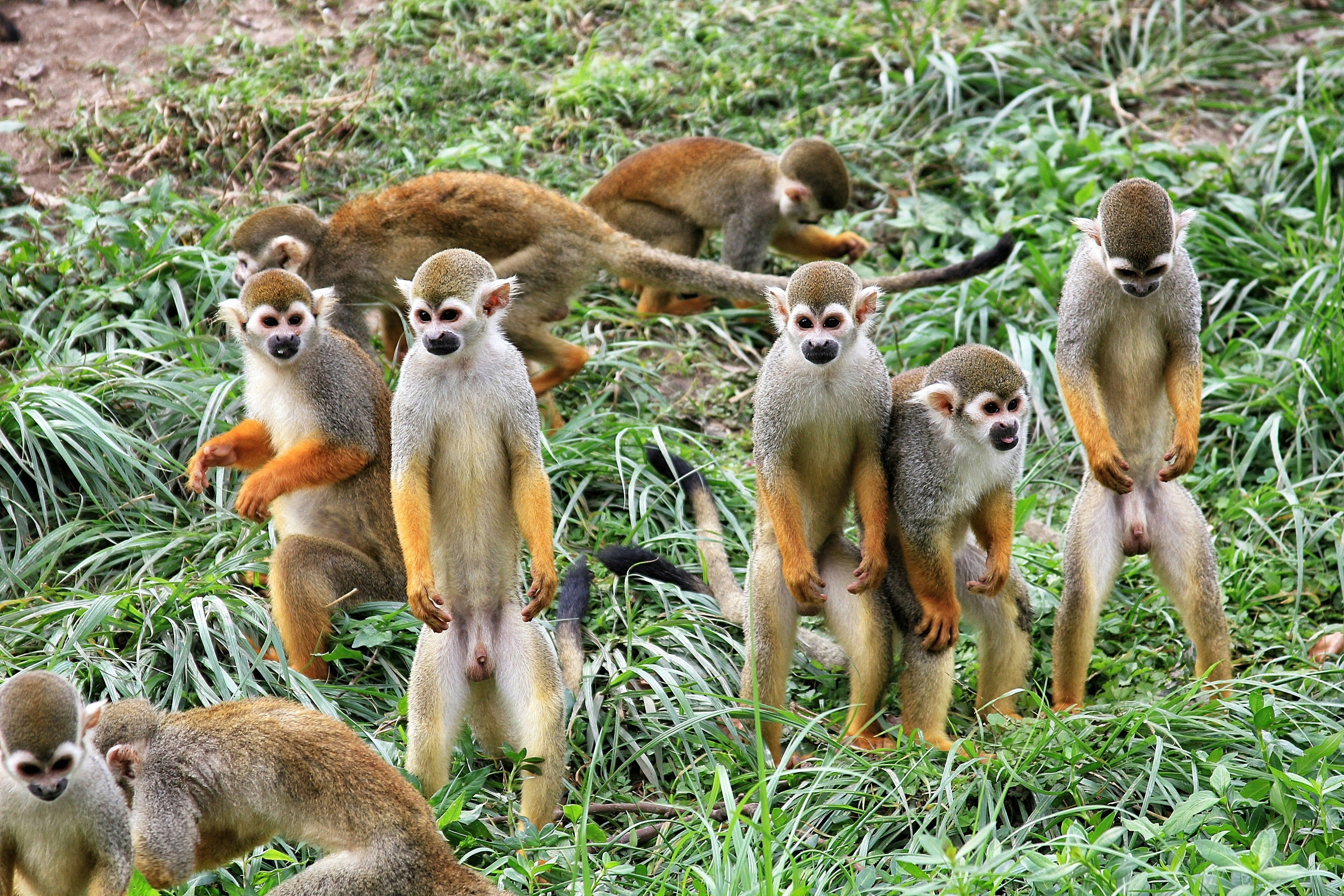
Ancient Buddhist traditions described the untrained mind as a drunk monkey. Someone once added to the image “with a thousand knives,” and it stuck, because it fits. Restless, reactive, cutting in every direction without intention or purpose. The practice wasn’t to kill the monkey. It was to learn to observe it from an unattached place. To find the part of you that watches the monkey rather than being the monkey.
The 21st century externalized the monkey.
All you have to do is open any social media or turn on the news and you get an infinite stream of digital chatter. And unlike the internal version, this one never sleeps, never tires, and is specifically engineered to keep you close to it rather than above it.
The solutions we’ve built are designed to restrict through blocking, deleting or putting time constraints. Yet, that requires an individual choice most of the time. What we need is digital infrastructure that allows us to engage with this without having to rely on our free will.
The social media companies have digital infrastructure designed to keep us listening directly to the inner chatter. They are incentivized to because they make money from our attention to all of it, despite the harm to our physical and mental health.
They built the monkey a megaphone. Nobody has yet to built a perch.
AI as a potential second layer
For the first time, we have a technology capable of doing what the oil light does, what the cube did, what the family therapist did with four animals in a room. AI can sit between us and the stream. It can read the flood, find the patterns, and return to us not more data but a signal. Not the raw feed but the emotional weather. Not the thousand knives but a sense of where the wind is blowing.
This is not what we have built it for yet. Right now AI is mostly being used to generate more content, more noise, more chatter for the monkey to swing through. It is, in the wrong hands and with the wrong incentives, the most powerful monkey amplifier ever created.
But it doesn’t have to be.
The same capability that makes AI dangerous in the hands of platforms optimizing for engagement makes it powerful in the hands of someone trying to build the perch. It can synthesize without censoring. It can translate without filtering. It can give us the signal beneath the noise, without taking away our agency over what we do with it.
The bear and the tornado and the tree didn’t disappear in that therapy room. They became navigable. That is what a second layer does. It doesn’t simplify the complexity. It changes where we stand in relation to it.
AI might be the first technology we have that can build that layer at scale. But a tool is only as good as the intentions of whoever builds with it. Which brings us to the harder question.
We need to build the perch
Every solution we have built for the social media problem has required individual willpower, putting down the phone, setting a timer, deleting the app. These are not infrastructure solutions. They are individual acts of resistance against a system designed by teams of engineers with billions of dollars and decades of behavioral data working against you, and the outcome is entirely predictable.
But there is something deeper than the willpower problem. The reason those solutions fail is not just that they require discipline. It is that they are built against our nature rather than with it.
The second layer we need follows the same logic. Infrastructure designed specifically around human emotional biology, around the fact that we feel before we think, that our brain gets hijacked when we get triggered, and that a symbol can reach us in that moment when a rational argument cannot.
What we need is digital emotional infrastructure.
Not another platform or another app that monetizes the time we spend inside it. Infrastructure in the same way that roads and electrical grids are infrastructure, sitting underneath everything, not owned by the entities that profit from our distraction, built collectively, the way we build the things we cannot afford to leave to the market. Designed around one purpose: to give us a layer between the raw stream and our reaction to it, a layer built from images, symbols, and emotional signals that our nervous systems can actually work with.
When my family had the four animals in the room, we could move them around. We could ask what happens when the tornado slows down, what the bear needs from the tree, how the peacock finds its footing when the storm picks up. We had agency inside the complexity because the complexity had been given a form our minds could actually hold and work with.
That is what this infrastructure would do. Not simplify the world or protect us from it, but give us the symbolic handles and emotional signals through which we can engage with it deliberately rather than reactively, and from which we can actually choose what to do next.
Every wisdom tradition knew we needed this and built accordingly, through ritual, symbol, image, and myth, the structures that held people above the chaos so they could act within it with some degree of intention and clarity. We let those structures erode in the digital age and replaced them with nothing.
But we are not without options. The monkey is not going away and the stream is not going to slow down. But for the first time we have the technological capacity to build the perch into the environment itself, not as a personal choice that requires discipline we don’t always have, but as shared infrastructure that works with our nature rather than against it.
The question is not whether we need to build this. We do. I don’t know exactly what it looks like yet, but I know that if we don’t build it, the digital stream of inner chatter will keep growing, pulling us further into a world that honors money over life.